< BACK TO NEWS
Women need to lead next phase of climate justice movement, Robinson says
Colorado.Edu • December 3, 2022

VIEW FULL ARTICLE HERE


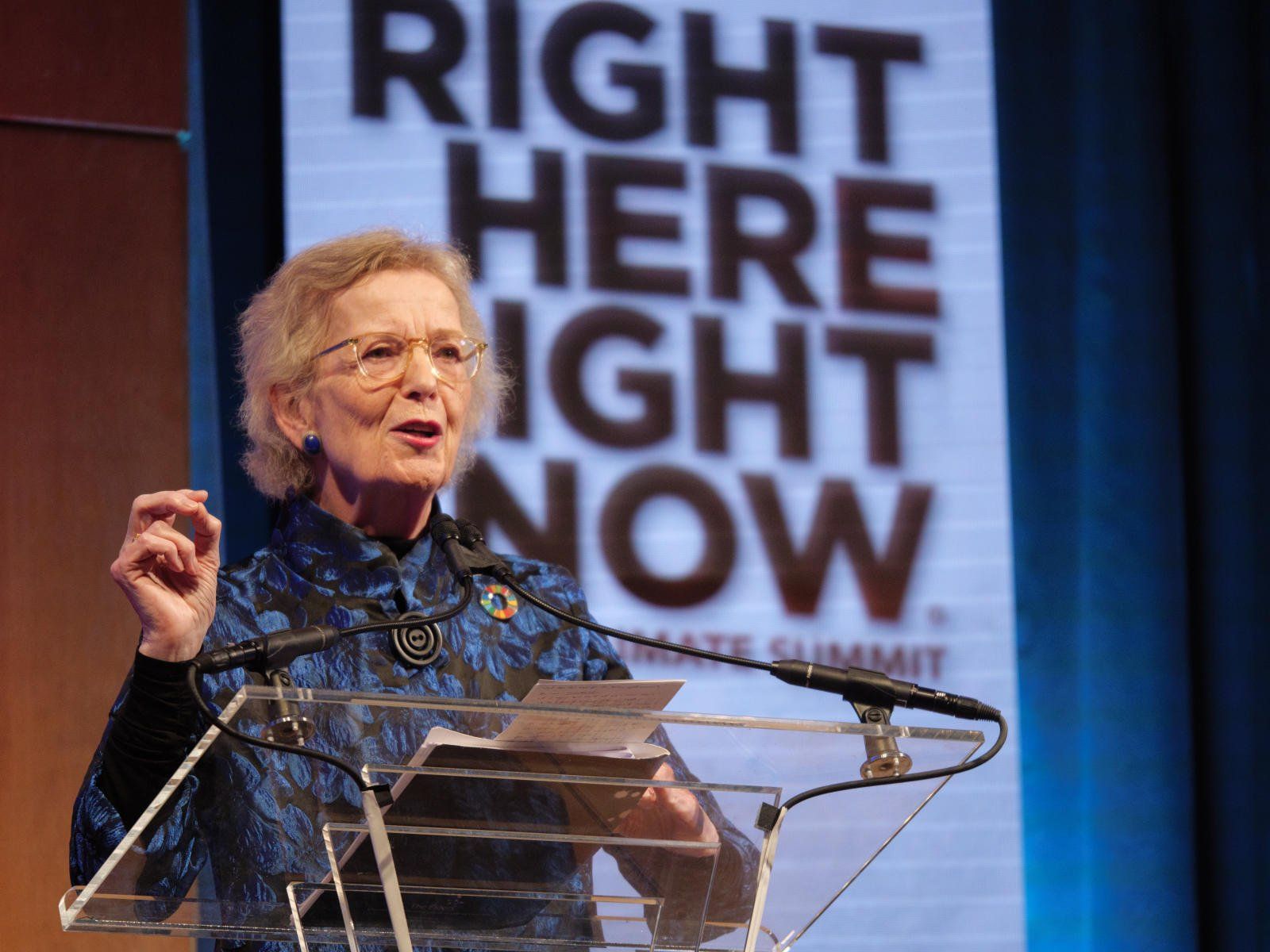
On the second day of the Right Here, Right Now Global Climate Summit, keynote speaker and former Irish President Mary Robinson posed a question about a pretty, yellow plant we all know but might not love: the dandelion.


She used the metaphor of the common weed to illustrate—and name—the latest climate justice movement taking root: Project Dandelion, the next phase of climate justice work, led by women. Dandelion seeds spread gently on the wind, and they grow on all continents around the world. To call them resilient is an understatement. 


"Have you ever tried to get rid of the damn thing?” she said to applause in the full Glenn Miller Ballroom at the University of Colorado Boulder.

Robinson was the second keynote in the inaugural Right Here, Right Now Global Climate Summit. 


While she announced Project Dandelion at COP27, her speech focused on the importance of building trust and including all perspectives and voices, and holding governments and corporations accountable for the financial and policy reforms urgently needed now to address climate change. 


One of the world’s most respected advocates for human rights and climate justice, Robinson said she hoped that, like the fast-growing dandelion, this movement would act as a feminist “moonshot” to achieve a more just and carbon-free world as quickly as possible.


“We have decided that what is needed is a women-led global climate justice movement, not women-only, but women-led,” said Robinson.


Climate injustices to address


Robinson cited five climate injustices that Project Dandelion aims to address:


First, that the climate crisis has disproportionately affected the poorest countries and communities, small island states, and Indigenous peoples. Second, the gender injustice within the climate crisis, noting that women and their children must travel further and suffer more in the face of climate change and disasters.

Third, the intergenerational injustices committed by her own generation, which have left younger generations with the possibility of an unlivable world. “We haven’t done what we should do,” said Robinson.


Fourth: the injustice of different development pathways. Developing countries around the world are told they now cannot use gas or oil to better their nations when it is the delay and lack of action on the part of developed countries that has led to this predicament.


Robinson said all nations and all people have to make not only a rapid, but a just transition, or we will not have a livable world.


Finally, the injustice to nature, which is especially important to Indigenous peoples around the world. In her time as U.N. High Commissioner for Human Rights, Robinson was coordinator of the Decade of the World’s Indigenous People, which taught her to listen first to Indigenous perspectives on climate issues.

 “Yet they're very often not delegates at the table and they find it very difficult to bring that wisdom to decision-making,” she said.


Leadership on climate justice


There are two words Robinson doesn’t use anymore: climate change. Instead, she uses either “climate crisis” or “climate justice.” It’s a purposeful choice to highlight the “deep connection” between the climate crisis and all human rights in her international advocacy and leadership.


During her tenure as president of Ireland (1990-97), Robinsonnever talked about climate change. It wasn’t until after five years as U.N. High Commissioner for Human Rights (1997–2002) that Robinson realized this critical connection when she saw firsthand how climate change was affecting several African countries and small island nations.


She went on to found the Mary Robinson Foundation (2010–2019), serve as the U.N. Special Envoy on Climate Change from 2014–2015, author the book Climate Justice: Hope, Resilience, and the Fight for a Sustainable Future, and be a founding member and current chair of The Elders, an esteemed group of former world leaders with a focus on creating a world where “people live in peace, conscious of their common humanity and their shared responsibilities for each other, for the planet and for future generations.” 


Getting fired up


Robinson was disappointed after COP27 concluded two weeks ago in Sharm el Sheikh, Egypt. It was touted as a COP of “implementation” but it did not deliver in important ways, she said.


While an agreement was reached to establish a fund for loss and damage and a link was made with reform of the international monetary system, “there was no move to increase ambition at COP27 by governments.”


“I came away from COP27 with a sense of what I can only describe as a terrible paradox,” said Robinson.


While we are on the cusp of a clean energy world, she said, we’re still heading for a catastrophic 2-degrees warming world.


“So what does this mean for the human rights community? I think it means one word, which we know and are familiar with but we have to really rise to: the word ‘accountability.’”


Robinson said she also aims to hold herself accountable, noting in her opening remarks that she traveled all the way from Dublin to be at the summit, and needed to justify her resulting carbon footprint.


She was going to do that, she said, “by making all of you as fired up as I was when I was leaving COP27 in Egypt a short time ago. I was fired up by anger and frustration and frankly, the fierce urgency of now.” 


In closing, Robinson asked the audience: “I want to know, are you fired up?” A sudden, loud round of applause and a standing ovation gave her an answer.


Share this post:

Additional Recent News
By RHRN News December 10, 2025
United Nations Human Rights, Saïd Business School, University of Oxford, and the Right Here, Right Now Global Climate Alliance Announce Multi-Year Plan to Host the Global Youth Climate Summit at Oxford on UN World Environment Day  Geneva, Switzerland – 10 December 2025 – On UN Human Rights Day, the Office of the United Nations High Commissioner for Human Rights (UN Human Rights), Saïd Business School, University of Oxford (Oxford Saïd), and the Right Here, Right Now Global Climate Alliance (RHRN) announced a multi-year plan to host the Right Here, Right Now Global Youth Climate Summit annually on UN World Environment Day (5 June). The annual Summit will be jointly hosted by Oxford Saïd and UN Human Rights, with co-hosting support from leading universities worldwide, including the University of Colorado Boulder. The Summit will convene young leaders, scholars, policymakers, educators, and innovators to advance human rights-based climate solutions. “Climate change is already harming the rights of millions of people - and young people refuse to accept a future defined by loss and injustice,” said Astrid van Genderen Stort, Chief of External Engagement and Partnerships at UN Human Rights. “This annual summit seeks to support youth voices in shaping the policies, technologies, and decisions that will define our shared future.” The multi-year initiative establishes Oxford Saïd as the annual home of the RHRN Global Youth Climate Summit, positioning it as a central, youth- and university-driven pillar of the wider RHRN Global Climate Alliance ecosystem. The summit will serve as a touchpoint for collaboration and capacity-building related to human rights-based climate action across campuses and communities around the world. “At Oxford Saïd, we believe education is the catalyst for lasting change,” said Josephine Fawkes, Director of Global Inclusion and Youth Education, Saïd Business School. “The Right Here, Right Now Global Youth Climate Summit convenes young leaders from across the globe, offering a growing platform where they can learn from one another, develop bold solutions, and turn inspiration into action. Their shared commitment and collective power will shape the future of our planet - and we are proud to help elevate their voices.” “Around the world, young people are rising - organizing, innovating, and refusing to accept a future defined by crisis. This summit is a powerful reminder that when institutions genuinely support young people through action, trust and access – they help turn potential into leadership. By aligning with youth voices, Oxford Saïd, UN Human Rights, and the RHRN Global Climate Alliance are creating the conditions for us to lead with purpose and build the future we all deserve,” says Aniba Khan, winner of Oxford Saïd Climate Change Challenge 2023 and an active participant of the RHRN Global Youth Climate Summit 2025. The theme for the 2026 RHRN Global Youth Climate Summit focuses on ensuring climate technologies for mitigation and adaptation are aligned with human rights obligations. It also focusses on developing the tools needed to ensure a just transition to sustainable economies and societies that uphold human rights. The Summit will explore the human rights risks and opportunities of current and emerging technologies like renewable energy systems, resilient infrastructure, data and early-warning tools, and AI in the context of climate action and identify strategies to ensure these risks are mitigated and human rights are upheld. The Summit will be hybrid, hosted physically at Oxford Saïd and livestreamed globally, enabling broad participation while limiting travel and associated environmental impacts. Young people from 12 regions will contribute through dialogues, case studies, and presentations on the intersection of climate change, human rights, and climate technology, highlighting scalable solutions that strengthen resilience and protect communities on the front lines. “This renewed commitment by Saïd Business School builds directly on the success of our inaugural Right Here, Right Now Global Youth Climate Summit last June, which engaged participants from 55 countries,” said David Clark, Founder of the Right Here, Right Now Global Climate Alliance. “Oxford Saïd’s leadership and steadfast support for youth-led climate justice have been invaluable, and I am deeply grateful for their partnership. Together with UN Human Rights, we are working to support youths in advancing transformative change for people and planet.” ABOUT Right Here, Right Now Global Climate Alliance Launched at COP26 with global partner UN Human Rights, the Right Here, Right Now Global Climate Alliance seeks to place human rights at the center of global climate decision-making. The Alliance brings together universities, youth, policymakers, scientists, technologists, cultural leaders, and media organizations to advance human rights-based climate solutions through summits, education, and global engagement programmes. UN Human Rights UN Human Rights represents the world’s commitment to protecting and promoting human rights for all. Climate change poses an urgent threat to rights including food, water, health, housing, culture, and life itself. The Office works to advance climate action that is grounded in human rights and support the central role of those most affected by climate change - including youth, Indigenous peoples, women, and marginalized communities - in global climate responses. Saïd Business School, University of Oxford Saïd Business School at the University of Oxford is a vibrant and innovative business school, embedded within a 900-year-old world leading university. It creates programmes and ideas that have global impact and reach, and educates educate leaders, change makers and innovators across every industry and sector. The School´s groundbreaking research and exceptional teaching transforms individuals, who transform businesses, which transforms the world. Saïd Business School´s focus is to create impact from within. University of Colorado Boulder The University of Colorado Boulder is Colorado’s leading public research university, transforming lives since 1876. Home to five Nobel Laureates and world-renowned atmospheric and geological sciences research, CU Boulder’s vision is to transform lives in service to a just and sustainable world. CU Boulder hosted the inaugural Right Here, Right Now Global Climate Summit with UN Human Rights in 2022 and is proud to support the upcoming RHRN Global Youth Summit through its Conference on World Affairs, Buckley Center for Sustainability Education and Center for African & African American Studies (The CAAAS | The Cause).
By UN Human Rights, Oxford University, Right Here, Right Now Global Climate Alliance, International Universities Climate Alliance July 3, 2025
Joint Statement from United Nations Human Rights, the University of Oxford, the International Universities Climate Alliance, and the Right Here, Right Now Global Climate Alliance
By CU Boulder Today June 10, 2025
Sheila Watt-Cloutier said she believes that educating people about the human impacts of climate change can bring the world together, even in times of political uncertainty and conflict.